
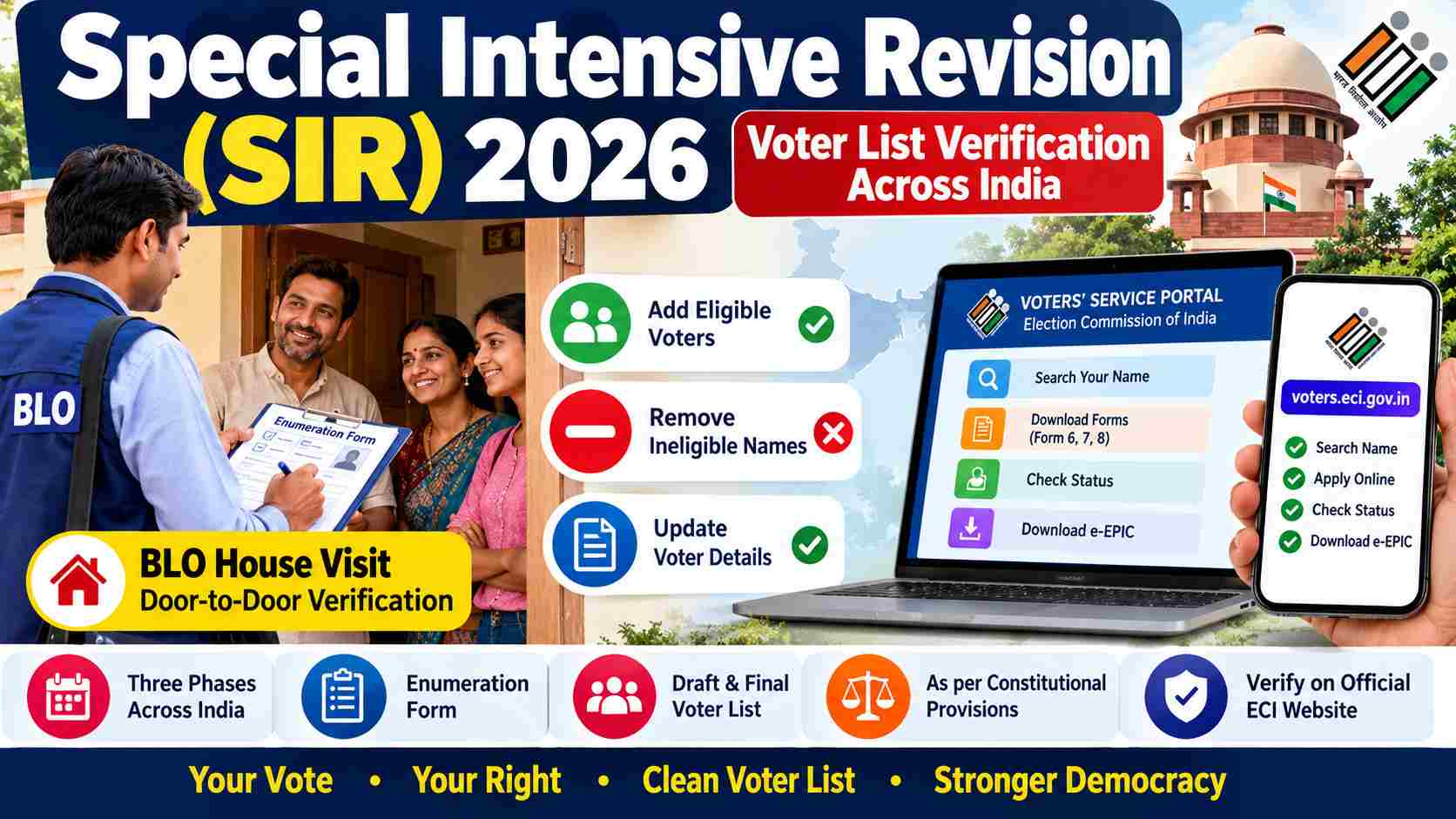
The Special Intensive Revision 2026 (SIR) is an important electoral-roll verification exercise being conducted by the Election Commission of India (ECI). The process is designed to improve the accuracy of electoral rolls by verifying existing voters, identifying eligible citizens who need to be enrolled and addressing issues such as duplicate entries, deaths, migration and other inaccuracies.
Under an intensive revision, Booth Level Officers (BLOs) may conduct house-to-house verification and collect information required for preparing or updating electoral rolls. The Election Commission’s legal framework for electoral-roll revision derives from Article 324 of the Constitution, the Representation of the People Act, 1950 and the Registration of Electors Rules, 1960.
The current SIR exercise has been implemented in phases. Bihar was covered in the first phase, followed by Phase II in 12 States/UTs, while the Election Commission announced Phase III in 19 States/UTs in May 2026.
For citizens, the most important point is simple: keep your electoral details updated, cooperate with the BLO where applicable, and check your name in the electoral roll through the official ECI voter services portal.
Table of Contents
Special Intensive Revision 2026 – Overview
| Particular | Details |
|---|---|
| Full Name | Special Intensive Revision |
| Short Name | SIR |
| Conducting Authority | Election Commission of India |
| Main Purpose | Verification and updating of electoral rolls |
| Key Field Officer | Booth Level Officer (BLO) |
| Legal Framework | Article 324, RPA 1950 and Registration of Electors Rules, 1960 |
| Current Exercise | SIR 2025-26/SIR 2026 |
| Phase I | Bihar |
| Phase II | 12 States/UTs |
| Phase III | 19 States/UTs |
| Online Voter Portal | voters.eci.gov.in |
| Voter Helpline | 1950 |
The official ECI voter services portal currently provides dedicated services for SIR 2026, including an option to fill an Enumeration Form and search one’s name in the relevant electoral roll.
What is Special Intensive Revision 2026?
Special Intensive Revision (SIR) is a special process for reviewing electoral rolls.
Unlike routine electoral-roll updates, an intensive revision can involve field-level verification. ECI’s electoral-roll manual describes intensive revision as a process in which enumerators or BLOs visit houses within their assigned polling-station areas and verify relevant information.
The objective is to ensure that the electoral roll reflects eligible voters as accurately as possible.
The exercise can help identify situations such as:
- Duplicate electoral-roll entries
- Names of deceased electors that have not been removed
- Voters who have permanently shifted
- Incorrect or incomplete voter information
- Eligible citizens who need to be enrolled
- Other discrepancies requiring verification
The goal is to maintain reliable electoral rolls for free and fair elections.
Why is SIR Important?
An accurate electoral roll is an important part of the election process.
People frequently move between cities and states for employment, education, marriage and other reasons. At the same time, deaths and changes in personal details may not always be reflected immediately in electoral records.
An intensive revision gives election authorities an opportunity to verify electoral information more comprehensively.
Key Objectives of SIR
The major objectives include:
- Improving the accuracy of voter lists
- Identifying duplicate entries
- Updating records after migration
- Removing records of deceased electors through the prescribed process
- Enrolling eligible citizens
- Correcting voter information
- Strengthening the integrity of electoral rolls
Legal Basis of Special Intensive Revision
The ECI’s June 2025 order on Special Intensive Revision refers to Article 324 of the Constitution and the Representation of the People Act, 1950, along with the Registration of Electors Rules, 1960. The order also notes that the Commission has previously exercised its revision powers during several periods, including 1952-56, 1957, 1961, 1965, 1966, 1983-84, 1987-89, 1992, 1993 and 1995.
Article 324
Article 324 gives the Election Commission of India superintendence, direction and control over the preparation of electoral rolls and the conduct of elections.
Representation of the People Act, 1950
The Representation of the People Act, 1950 provides the statutory framework concerning electoral rolls and related matters.
Registration of Electors Rules, 1960
The Registration of Electors Rules provide procedural provisions concerning the preparation and revision of electoral rolls.
SIR History in India
The concept of intensive electoral-roll revision has a long history in India.
The Election Commission’s historical records and its 2025 SIR order refer to previous exercises dating back to the early years of the Republic.
Major Historical Periods
| Period | Electoral Revision Activity |
|---|---|
| 1952-56 | Early intensive revision exercises |
| 1957 | Revision exercise |
| 1961 | Revision exercise |
| 1965 | Revision exercise |
| 1966 | Revision exercise |
| 1983-84 | Intensive revision activity |
| 1987-89 | Intensive revision activity |
| 1992 | Revision activity |
| 1993 | Revision activity |
| 1995 | Revision activity |
| 2002-04 | Intensive revision exercises in different areas/states |
| 2025–26 | Large-scale SIR exercise in phases |
The exact scope and dates of individual historical revisions varied by state and electoral circumstances.
SIR 2025-26: Three-Phase Structure
The current exercise was implemented in phases.
Phase I – Bihar
Bihar was the first major state covered under the current SIR exercise.
The Election Commission’s June 2025 order directed a Special Intensive Revision of electoral rolls in Bihar. The Supreme Court’s later judgment records that the Bihar SIR was initiated by the ECI through its June 24, 2025 order.
The Bihar exercise involved house-to-house enumeration and subsequent stages for claims, objections and verification.
Phase II – 12 States/UTs
Following Bihar, the Election Commission announced Phase II covering 9 States and 3 Union Territories.
The ECI stated that Phase II covered:
States:
- Chhattisgarh
- Goa
- Gujarat
- Kerala
- Madhya Pradesh
- Rajasthan
- Tamil Nadu
- Uttar Pradesh
- West Bengal
Union Territories:
- Andaman and Nicobar Islands
- Lakshadweep
- Puducherry
The ECI’s November 2025 press note stated that enumeration forms were being distributed in all 12 States/UTs.
Phase III – 19 States/UTs
In May 2026, the Election Commission announced Phase III of SIR in 19 States/UTs.
The Phase III exercise is therefore broader than the earlier two phases and involves electoral-roll revision in multiple parts of the country.
Citizens should check the website of their respective Chief Electoral Officer (CEO) for state-specific dates and instructions because schedules can differ between states and Union Territories.
Role of the Booth Level Officer (BLO)
The Booth Level Officer (BLO) is one of the most important field-level officials involved in electoral-roll verification.
Depending on the applicable SIR schedule and instructions, a BLO may:
- Visit households
- Provide or collect prescribed forms
- Verify electoral information
- Assist eligible citizens with enrolment-related procedures
- Report discrepancies
- Update information through the prescribed election-management system
- Provide information regarding the electoral-roll process
ECI’s electoral-roll manual describes house-to-house verification as a feature of intensive revision.
What is the Enumeration Form?
During an SIR exercise, the Election Commission may provide an Enumeration Form or other prescribed form to existing electors according to the applicable state-specific instructions.
The form is used to collect or verify information required for the electoral-roll revision.
Citizens should:
- Read the form carefully.
- Check pre-filled information, if provided.
- Correct information wherever permitted.
- Provide the required declarations/details.
- Sign the form where required.
- Submit it through the prescribed process.
- Keep the acknowledgement or copy, where applicable.
The exact fields and supporting requirements can differ according to the ECI’s instructions applicable to the relevant SIR phase.
What Should You Do When a BLO Visits Your Home?
If an SIR exercise is active in your area, citizens should cooperate with the official process.
Do:
- Keep your voter/EPIC details available.
- Check your name and details carefully.
- Provide accurate information.
- Complete the prescribed form correctly.
- Keep a copy or acknowledgement where provided.
- Check the electoral roll after publication of the draft roll.
- Contact the official election authorities if you have questions.
Do Not:
- Pay money to anyone claiming to be a BLO for routine electoral-roll services.
- Provide false information.
- Give sensitive information to unauthorised persons.
- Rely on unofficial social-media messages for deadlines.
- Assume that your name is safe without checking the electoral roll.
For official online services, use the ECI’s voter services portal rather than an unknown website.
How to Check Your Voter Details Online
The official ECI Citizen Service Portal provides voter-related services, including SIR-related services.
Step-by-Step Process
Step 1: Visit the official ECI voter services portal.
Step 2: Log in or register if required.
Step 3: Use the available electoral-roll search service.
Step 4: Enter the required information.
Step 5: Check your name and voter details.
Step 6: If you find an error or your name is missing, follow the applicable ECI process for correction, inclusion or objection.
The official portal currently displays dedicated SIR 2026 options including “Fill Enumeration Form” and “Search Your Name in Last SIR.”
Forms Related to Electoral Registration
Different forms are used for different electoral-roll requirements.
| Form | General Purpose |
|---|---|
| Form 6 | New voter registration |
| Form 6A | Registration of an overseas/NRI elector |
| Form 7 | Objection to inclusion/deletion-related request |
| Form 8 | Correction or update of voter details |
The ECI’s official voter services portal currently provides online access to Form 6, Form 6A and Form 7 services and related voter facilities.
Citizens should always check the latest instructions before submitting a form because procedures can be updated.
What If Your Name Is Missing From the Voter List?
If your name does not appear in the electoral roll, do not panic.
First, check whether:
- You searched using the correct details.
- Your polling area has changed.
- Your name appears under a different spelling.
- Your electoral record has been shifted.
- Your state has completed or is currently conducting an SIR exercise.
If you are eligible for registration, use the applicable ECI procedure, including Form 6 where appropriate. The official ECI portal provides a dedicated new-voter registration service.
Claims and Objections After Draft Electoral Roll
After publication of a draft electoral roll, the Election Commission provides a prescribed period during which eligible citizens and other stakeholders can submit claims and objections.
Depending on the issue, citizens may need to use the appropriate electoral form or procedure.
Examples include:
- Requesting inclusion of an eligible voter
- Requesting correction of voter information
- Raising an objection regarding an entry
- Requesting deletion where legally applicable
The exact dates and procedures should be checked in the relevant state/UT’s official election notification.
SIR 2026 vs Normal Voter Registration
| Feature | Special Intensive Revision | Normal Electoral Registration |
|---|---|---|
| Purpose | Broad verification/revision exercise | Routine enrolment/update |
| Field Verification | May involve house-to-house verification | Depends on case/process |
| Main Field Official | BLO | BLO/ERO/AERO as applicable |
| Coverage | Specified areas under SIR order | Eligible individual applicants |
| Forms | Prescribed SIR/Enumeration forms | Forms such as 6, 7 and 8 |
| Draft Roll | Published according to SIR schedule | According to applicable revision process |
| Claims & Objections | Scheduled period | As provided under applicable rules |
Supreme Court and Bihar SIR
The Bihar SIR became the subject of litigation before the Supreme Court of India.
In Association for Democratic Reforms v. Election Commission of India, the Supreme Court considered questions concerning the ECI’s authority to conduct a Special Intensive Revision, the purpose and proportionality of the exercise, the applicable statutory framework and issues concerning citizenship-related scrutiny.
The Supreme Court’s landmark-judgment summary records that the Bihar SIR was ordered by the ECI on 24 June 2025 under Article 324 read with Section 21(3) of the Representation of the People Act, 1950.
The Court’s judgment was delivered on 27 May 2026. The complete judgment is available through the Supreme Court of India’s official website.
For this reason, readers should avoid social-media claims that simply describe the judgment as a blanket declaration that every aspect of every SIR exercise is “fully constitutional.” The actual judgment contains the Court’s detailed reasoning and directions and should be read for the precise legal position.
Important Advice for Voters
If SIR is being conducted in your area, take the following steps:
- Check whether your name appears in the electoral roll.
- Keep your EPIC/voter information available.
- Cooperate with the official BLO verification process.
- Fill the prescribed forms carefully.
- Do not provide false information.
- Keep acknowledgement/copies of submitted documents where available.
- Check the draft electoral roll when published.
- Submit claims or objections within the prescribed period if necessary.
- Use only official ECI/CEO websites.
- Call 1950 for voter-related assistance where applicable.
Frequently Asked Questions
What is Special Intensive Revision 2026?
Special Intensive Revision 2026, commonly called SIR 2026, is an Election Commission exercise for reviewing and updating electoral rolls through a more intensive verification process.
Why is the Election Commission conducting SIR?
The purpose is to improve the accuracy and integrity of electoral rolls by identifying discrepancies and ensuring that eligible voters are properly represented in the electoral roll.
What does BLO mean?
BLO stands for Booth Level Officer. BLOs are field-level election officials who assist with electoral-roll-related work and verification.
Will a BLO visit my house?
If your area is covered by an active SIR or house-to-house verification exercise, a BLO may visit your household according to the schedule issued by the election authorities.
How can I check my voter-list details?
You can use the official ECI Citizen Service Portal to search voter information and access SIR-related services.
What should I do if my name is missing?
First search the electoral roll carefully. If you are eligible but your name is missing, follow the applicable ECI registration process, including Form 6 where appropriate.
What is Form 6?
Form 6 is generally used for new voter registration for eligible citizens. The ECI’s official voter portal provides a Form 6 service.
What is Form 7?
Form 7 is used for certain objection/deletion-related electoral-roll requests. The official ECI portal provides Form 7 services.
What is Form 8?
Form 8 is generally associated with correction or updating electoral-roll details. Candidates/voters should follow the latest ECI instructions while submitting it.
Is Aadhaar automatically proof of citizenship?
No. Aadhaar should not be treated as a general proof of citizenship merely because it is used for identity-related purposes in an electoral process. The applicable ECI/court instructions should always be followed.
Is SIR the same as normal voter registration?
No. SIR is a special electoral-roll revision exercise, whereas normal voter registration is an individual service for eligible citizens seeking enrolment or updating their details.
When will the SIR process finish in my state?
The date depends on the phase and state/UT-specific schedule. Citizens should check their respective Chief Electoral Officer website and official ECI notices for the latest schedule.
Where can I get official SIR information?
The safest sources are the Election Commission of India, the official ECI voter services portal, and the website of your State/UT Chief Electoral Officer.
Official Links
Election Commission of India:
Election Commission of India – Official Website
ECI Voter Services / SIR 2026:
ECI Citizen Service Portal – SIR 2026
Supreme Court of India:
Supreme Court of India – Official Website
Check Latest Yojana: Click Here
Voter Helpline: 1950
Conclusion
The Special Intensive Revision 2026 (SIR) is an important electoral-roll exercise being undertaken by the Election Commission of India in phases. The process is intended to strengthen the accuracy of electoral rolls through verification, updating and prescribed claims-and-objections procedures. For citizens, the most important actions are to check their voter details, cooperate with the official election machinery where applicable, complete prescribed forms accurately and verify the draft/final electoral roll when it is published. Do not rely on forwarded WhatsApp messages or unofficial websites for SIR deadlines, forms or legal information. Always verify the latest information through the Election Commission of India or the relevant State/UT Chief Electoral Officer.
Disclaimer
RozgarAI.com is a private informational website and is not affiliated with any government department or the Election Commission of India. Information may change based on official updates. Readers should verify details through official ECI/CEO websites before taking action. RozgarAI.com does not charge any fee for accessing this information.
